REGIONS IN FOCUS
Asia Overview
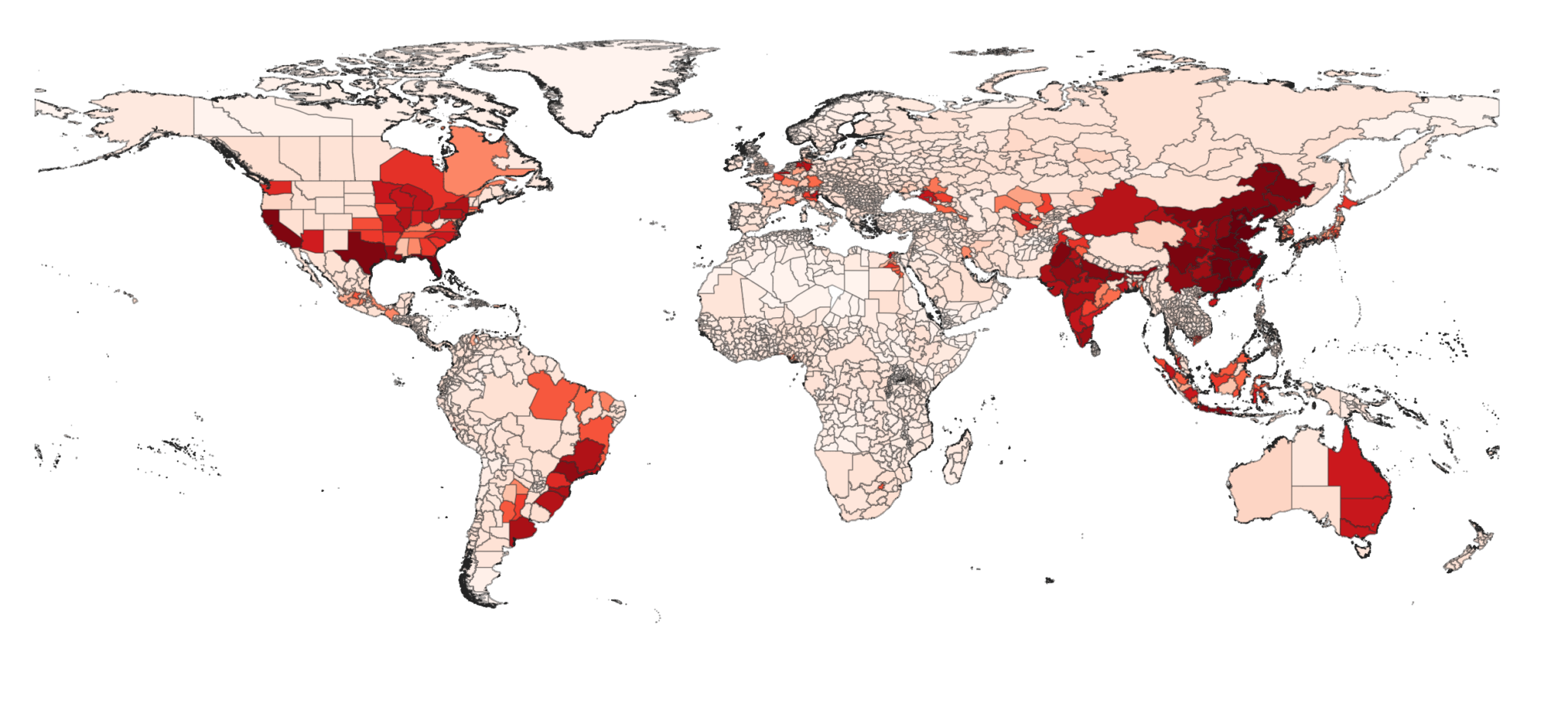
Ranking of physical climate risk to the built environment in 2600+ territories in the world.
Asia dominates the list of provinces at risk by Aggregated Damage Ratio, with more than half (114) of the top 200 in 2050 in this region.
- More than a quarter (53) of these are in East Asia: 29 in China, 20 in Japan and 4 in South Korea.
- 36 of the top 200 are in South East Asia, notably Vietnam and Indonesia.
- South Asia has 24 of the top 200. After China, India has the highest number of states in the top 50 (9), with Punjab, Bihar, Uttar Pradesh and Assam ranking highest. Pakistan also has multiple provinces in the top 100, including Sindh province. Devastating flooding between June and August 2022 affected 30 per cent of the area of Pakistan and has partially or fully damaged more than 900,000 houses in Sindh province.
- East Asia and South East Asia see the greatest increase in Average Damage between 1990 and 2050, and China in particular has many provinces with the greatest overall Aggregated Damage Ratio. This increase and overall risk to the built environment in 2050 is driven predominately by sea level rise and secondarily by flooding risk” in the Asia section should read “by flooding and coastal inundation.
- The analysis highlights the vulnerability of major cities in East Asia and South East Asia including Jakarta, Beijing, Hồ Chí Minh City and Taiwan.
Related posts

XDI Corporate Footprint Methodologies for Risk and Resilience in ResilienceArc
Knowing which corporate assets are exposed to climate hazards does not tell investors whether a company can withstand the resulting damage and disruption. XDI’s new methodology paper explains how its analysis for ResilienceArc - a collaboration between non-profit Arc, Earth Capital Nexus at the London School of Economics and Political Science, and XDI - moves beyond direct asset risk to capture the wider pathways through which climate impacts can impair company operations and revenue, including infrastructure dependencies, regional economic disruption and supply chains. It sets out the methodologies behind two new corporate resilience indicators, Asset System Resilience and Revenue Impairment, creating a consistent way to assess and compare physical climate risk and resilience across thousands of global companies.
2026 Global Analysis of Planned Data Centres for Physical Climate Risk and Resilience - Key Findings Report
Billions of dollars are flowing into the global AI infrastructure boom, but XDI’s new analysis released ahead of London Climate Action Week warns some of the world's fastest-growing data centre investment hubs are also emerging as climate-risk hotspots.
The 2026 Global Analysis of Planned Data Centres for Physical Climate Risk and Resilience examines 2,595 planned data centres worldwide, identifying locations where either physical damage to the built infrastructure due to direct climate impacts, or operational disruption due to heat or indirect risks, could increasingly challenge long-term infrastructure performance, insurability and operational continuity.

LA Fires Case Study
LA Fires Case Study
By the end of January 2025, wildfires in Los Angeles had destroyed or damaged over 18,000 structures, claimed at least 29 lives and forced approximately 200,000 residents to evacuate. Alarmingly, fewer than a quarter of damaged properties were insured against fire. The event is the costliest wildfire in U.S. history, impacting the insurance industry globally. In this case study XDI focused on comparing the results of its modelling with the real areas affected by the 2025 LA fires, and future forest fire risk in LA County and California more broadly under a high emissions scenario (RCP 8.5/SSP 5-8.5) in five-year intervals from 1990 until 2100.

Flooded Future: Europe's Rising Economic Risk
Europe’s financial and industrial engines are facing escalating risk of damage due to climate change extreme weather, with the risk of flood damage to property and infrastructure already estimated to be 30% worse due to climate and projected to double by 2100 under a high-emissions scenario, according to XDI's new benchmarking report.
Contact us
Get in touch with one of our friendly team